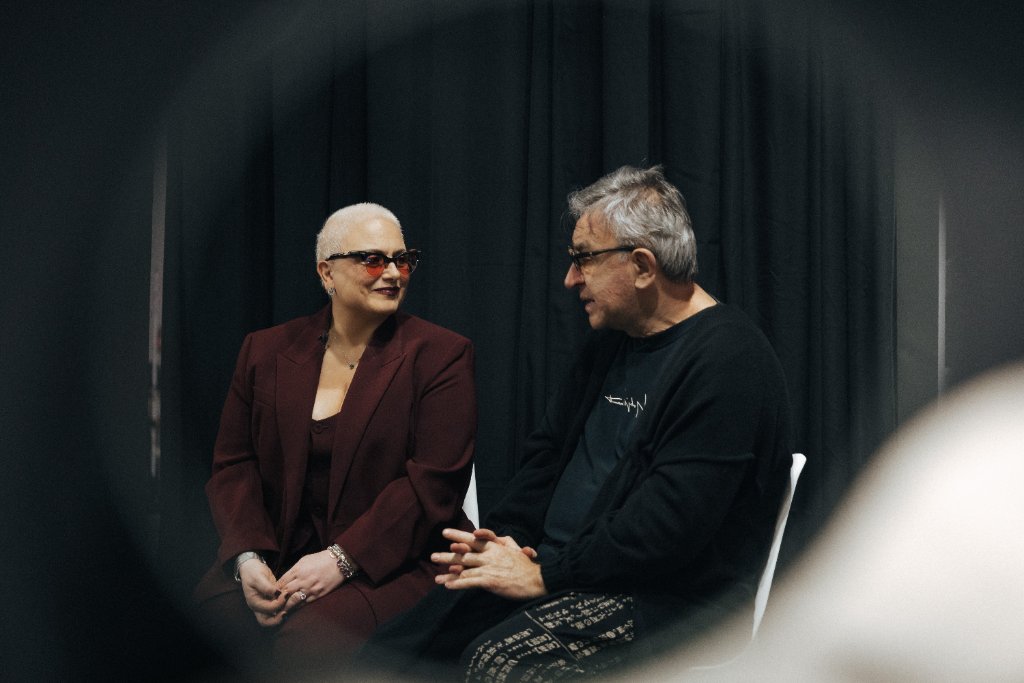
It was 1996. The internet in Italy was a word that most people had never heard. I was 20, studying Communication Sciences in Turin — the second year that degree programme existed, when classes were still held in cinemas — and I had just sold my digital piano to buy a PC and a desk to put in my room.
I'd installed my first modem, a Creative 33.6. Everyone laughed at me. To me it already seemed like everything.
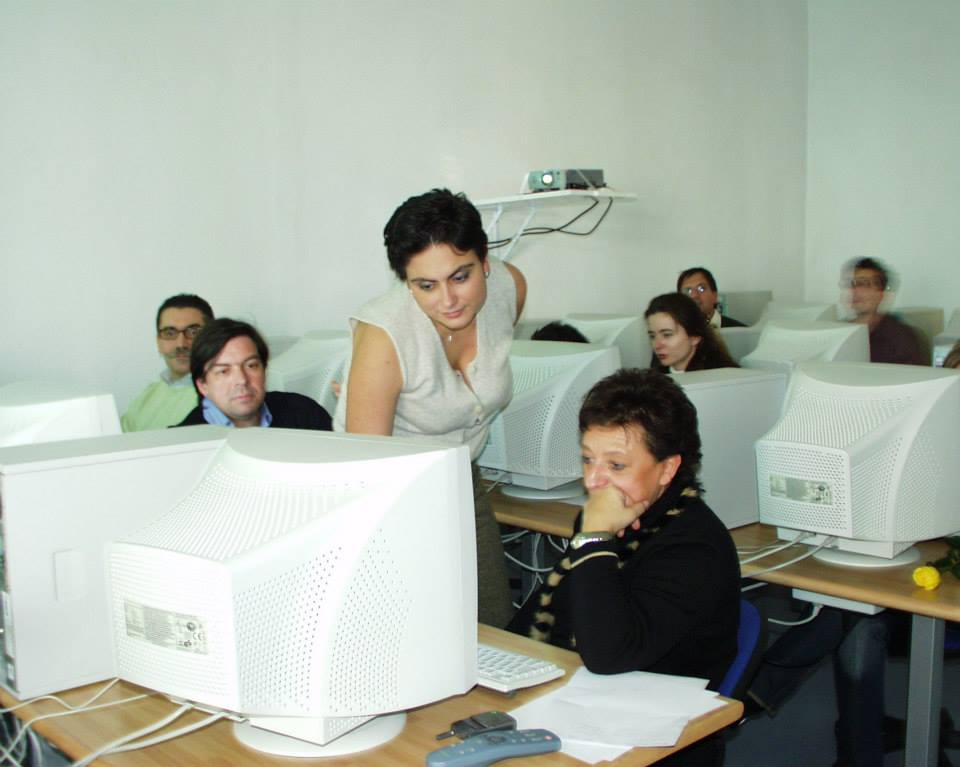 An old photo of the first NEAR headquarters, equipped with a computer training room, during a training session on the use of the web and email in the late 1990s.
That's where it all started.
What follows isn't a story of linear success. It's the story of what I learned by doing — and by getting things wrong — in an era when there were no manuals, no models, no mentors. There was just the technology, the desire to understand, and the unshakeable conviction that this strange thing called the web was changing everything.
Asti, 1995: nerds, modems and the council's civic network
In Asti there was an association called Oasi — Organizzazione Assigiana Sviluppo Informatico. A mixed group of nerds who were already tinkering with these technologies. I was perhaps the only girl around them, or almost.
The summer before opening my agency, I'd worked with Oasi on a project for the Municipality of Asti: the civic network, one of the first structured municipal websites in Italy. I did it all summer, without earning a penny. It never even crossed my mind to ask for anything in return. I wanted to learn. I wanted to show what I could do.
That structure lasted, I was told, until the last website redesign. Not bad for a summer of free work at twenty.
I worked all summer at the Council without earning a penny. It never crossed my mind to ask for anything. I wanted to show what I could do.
1996: the notary, NEAR and the partner who disappeared
Together with a friend from Oasi — also a student, also passionate — we decided to found a web agency. Not to make money: to have a practice ground. That way, by the time we graduated, we'd already have a portfolio to show.
We went to the notary. We founded NEAR SNC. We were excited.
Then he disappeared. For months. His own reasons, jealousies, young people's things. When I went to find him, he confessed he'd decided to give up. He'd help me in secret, when he could. But the company was mine.
I had a fork in the road: keep going alone, or give up too. I kept going. With my little computer, my pigtails, and zero connections.
That choice — perhaps a bit reckless, certainly driven by passion more than calculation — was the moment that determined everything that followed.
The first clients: word of mouth, trust and eight languages including Russian
The first real client was the father of a classmate. He had a pasta machine company. I built his website. It was 1995-96. I did it in eight languages, Russian included — which meant figuring out Cyrillic character encoding from scratch, on Notepad.
Not because anyone had asked me to. Because it made sense to do it properly, and doing it properly meant doing it for the market that client wanted to reach.
He was happy. He introduced me to his suppliers. I got to Milan. I built one of the very first music e-commerce sites in Italy, then one for comics. NEAR grew. We reached 14 employees in Asti. I was prouder than ever.
I wanted to prove that from a small city in Piedmont you could do serious communications work, without being in Milan. For me it was a matter of pride.
The problem I hadn't foreseen: 80 million lire a year for bandwidth
There was just one problem. I had the server farm at home, and to get the bandwidth I needed I was spending about 80 million lire a year on CDN. Just for the connection.
I had no business experience. I had a lot of passion and considerable technical skill, but I didn't yet know how to manage a business model so heavy in terms of infrastructure. The mistake wasn't the ambition — it was that the infrastructure of the time made what I wanted to do from a city like Asti almost impossible.
This is one of the mistakes I look back on most honestly: I hadn't understood that some battles can't be won by willpower. You win them when the context is ready. The context wasn't ready yet.
The dinner that changed everything: optics and specialisation
My father was an eyewear sales rep. He knew a publisher — the key figure in communications for the Italian optics sector. He convinced him, after months of persistence at trade fairs, to give me an appointment.
One evening at dinner: me, my father, this entrepreneur and his right-hand man. I explained what could be done by combining his content, his connections in the market, with my digital skills.
Two days later I was his right-hand person for everything digital. From there I built a vertical expertise in the optics sector that I carry to this day. From there came Eyemage. From there came twenty years of relationships, clients, conferences, books.
The specialisation hadn't been a strategic decision made at a planning table. It had come from a dinner, from my father who had believed in me, and from an entrepreneur who had the courage to bet on a girl with pigtails talking to him about the internet.
What I learned: the lessons I still carry today
LESSON 1 — Passion isn't enough, but without it you go nowhere I made reckless choices, worked for free, kept going alone when I could have quit. Not by calculation: by conviction. That conviction was my most valuable resource in difficult moments.
LESSON 2 — Strategic generosity opens doors a CV can't The summer at the Council, projects done at my own expense, always saying yes when there was something to learn: these weren't acts of selflessness. They were how I built networks and demonstrated value before I had a track record.
LESSON 3 — Specialisation is what turns a freelancer into a reference point When I did everything for everyone, I was good but interchangeable. When I started building vertical expertise in optics, I became the person to call for that specific market. The niche doesn't limit: it amplifies.
LESSON 4 — Some battles can't be won by willpower alone I wanted to do everything from Asti, in an era when the infrastructure didn't allow it. I spent enormous resources fighting a structural limit instead of working around it. Recognising context constraints is an entrepreneurial skill, not surrender.
LESSON 5 — Technology is always a means, never an end I understood this immediately, in 1996, and have never changed my mind. The most beautiful website in the world is useless if it doesn't communicate something real. Technology is the channel. Content is the message. Confusing them is still the most common mistake today.
The thread connecting 1996 to now
I look back and see a continuous line. Not straight — full of curves, detours, moments when I didn't know where I was going. But continuous.
The same thing that made me sell my piano to buy a PC is the same thing that led me to study AI when everyone was still looking at it with suspicion. The same thing that made me work all summer at the Council without being paid is the same thing that still makes me go to Rome at my own expense for a project I believe in.
It's not a strategy. It's a character. And if there's one thing I've learned in thirty years, it's that character, in the long run, almost always beats strategy.
The web of 1996 and the AI of 2025 have one fundamental thing in common: both seemed too complicated, too technical, too far from real business. In both cases, those who understood early had an enormous advantage. In both cases, the advantage wasn't technical. It was one of vision.
Character, in the long run, almost always beats strategy.